Skip to content

Planning a home extension often brings confusion about which drawings you really need. Many UK homeowners mistake a site plan for a floor plan, yet a site plan gives a detailed aerial view of your entire property and how any proposed new building integrates with the surroundings. Knowing these differences can spare you delays or rejected applications. This guide breaks down the essentials so you understand what planners expect before you spend money or submit paperwork.
Table of Contents
- Site Plan Basics: Definition And Misconceptions
- Types Of Site Plans In Home Extensions
- Core Features Of A Site Plan Drawing
- Legal Requirements For Planning Permission
- Costs, Common Errors, And Practical Tips
Key Takeaways
| Point | Details |
|---|---|
| Understanding Site Plans | Site plans are detailed architectural drawings that depict a property’s external layout, crucial for obtaining planning permission for extensions or renovations. |
| Comparison with Floor Plans | Site plans focus on external environments, while floor plans illustrate internal room layouts, making them fundamentally different documents. |
| Importance of Professional Services | Commissioning professional architectural services ensures compliance with local regulations and improves the likelihood of successful planning permission. |
| Budgeting and Preparation | Homeowners should prepare for a range of costs and potential strategic errors, budgeting an additional 20% for unforeseen expenses in their planning process. |
Site Plan Basics: Definition and Misconceptions
A site plan is a precise architectural drawing that provides a comprehensive aerial view of a property’s layout and surrounding environment. It serves as a critical document for homeowners contemplating extensions or renovations, offering a detailed representation of how proposed changes interact with the existing landscape. Site plans from a bird’s-eye perspective capture far more than simple blueprints, encompassing crucial spatial relationships and contextual details.
These technical drawings typically include several key elements that help planning authorities and construction professionals understand the proposed development:
- Property boundaries and exact land measurements
- Location and footprint of existing and proposed structures
- Landscaping features and external elements
- Access points and circulation routes
- Levels and topographical information
- Relationship to neighbouring properties
Many UK homeowners mistakenly confuse site plans with floor plans, but they serve distinctly different purposes. Comprehensive architectural drawings focus exclusively on external site context, providing a holistic view that floor plans cannot capture. Site plans are typically drawn at precise scales such as 1:500 or 1:200, depending on the project’s complexity and specific requirements.
Here’s how site plans and floor plans differ in purpose and use:
| Aspect | Site Plan | Floor Plan |
|---|---|---|
| Primary Focus | External property and surroundings | Internal room layout |
| Scale | Usually 1:500 or 1:200 | Typically 1:100 or 1:50 |
| Planning Relevance | Required by local authorities | Used mainly for interior alterations |
| Legal Status | Often legally binding | Advisory, rarely legally binding |
Common misconceptions about site plans can lead to significant planning challenges. Homeowners often believe these documents are simple sketches, when in reality, they represent legally binding technical drawings that must meet strict local authority standards. Accurate site plans demonstrate how proposed extensions will integrate with existing infrastructure, drainage systems, and neighbouring properties.
Pro Tip: Always commission your site plan from a professional architectural service to ensure compliance with local planning regulations and avoid potential rejection of your extension proposal.
Types of Site Plans in Home Extensions
Homeowners embarking on property extensions must understand the various types of site plans that align with different project scales and regulatory requirements. Specific extension types demand unique approaches to site plan documentation, with each category presenting distinct planning challenges and considerations.
The primary categories of site plans for home extensions in the UK include:
-
Single-Storey Extension Site Plans
- Typically smaller in scale
- Often qualify under permitted development rights
- Require detailed boundary and footprint measurements
-
Two-Storey Extension Site Plans
- More complex architectural documentation
- Generally require full planning permission
- Must demonstrate comprehensive impact on existing property
-
Rear Extension Site Plans
- Focus on garden and backyard spatial relationships
- Include precise measurements of existing structures
- Highlight potential impact on neighbouring properties
-
Side Extension Site Plans
- Emphasise boundary interactions
- Detail potential changes to property’s external appearance
- Demonstrate compliance with local planning regulations
Each site plan must meticulously illustrate the proposed development’s interaction with existing infrastructure, ensuring transparent communication with local planning authorities. Professional architectural services can help homeowners navigate these complex documentation requirements, transforming technical drawings into successful extension proposals.

The complexity of site plans varies significantly depending on the extension’s scope and location. Urban properties with tight spatial constraints often require more detailed documentation compared to suburban or rural settings. Factors such as neighbouring building proximity, conservation area restrictions, and potential infrastructure impacts play crucial roles in determining the site plan’s depth and complexity.
Pro Tip: Consider consulting a professional architectural service early in your planning process to ensure your site plan meets all local authority requirements and increases the likelihood of planning permission approval.
Core Features of a Site Plan Drawing
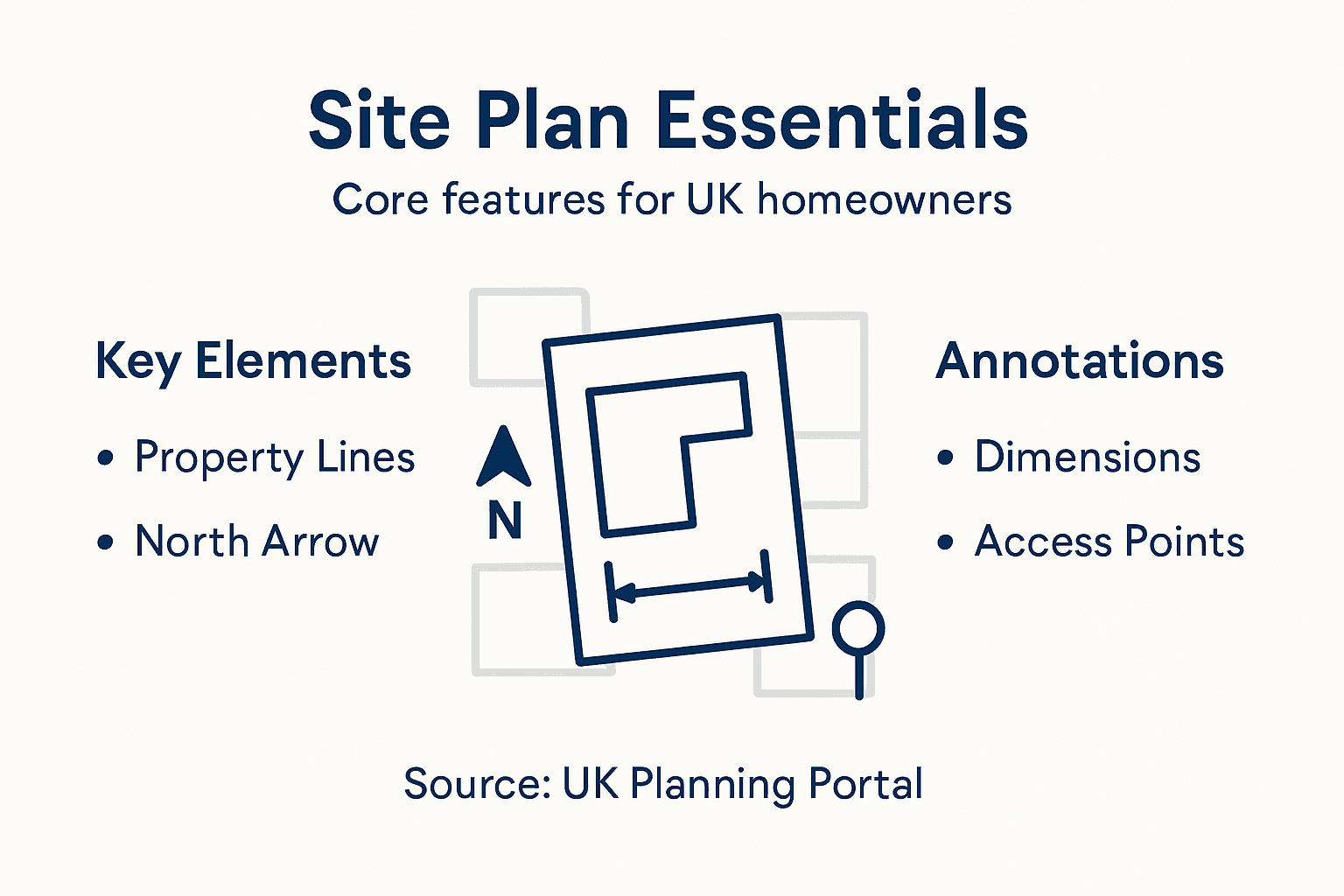
A comprehensive site plan drawing serves as a detailed visual blueprint that communicates critical information about a property’s existing and proposed configurations. Site layout plans provide local authorities and stakeholders with a precise understanding of proposed development through meticulous graphical representation.
The essential components of a professional site plan drawing typically include:
-
Boundary Details
- Precise property line measurements
- Exact property dimensions
- Clear demarcation of existing and proposed boundaries
-
Structural Elements
- Location of existing buildings
- Proposed new construction footprints
- Indication of structures to be demolished
-
Landscape Features
- Tree positions and species
- Garden and open space allocations
- Existing and proposed vegetation
-
Infrastructure Annotations
- Roads and access points
- Parking arrangements
- Footpaths and rights of way
A site plan is more than a drawing—it’s a comprehensive communication tool that translates complex spatial relationships into a clear, understandable format.
Additional critical elements include a north arrow for orientation, detailed dimensional annotations, and comprehensive documentation of site components. Professional site plans must distinguish between existing, proposed, and demolition elements, ensuring absolute clarity for planning authorities.
The complexity of site plan drawings varies significantly depending on the project’s scope and location. Urban developments often require more intricate detailing compared to rural extensions, with factors like conservation area restrictions, neighbouring building proximity, and infrastructure impacts dramatically influencing the plan’s depth and complexity.
Pro Tip: Invest in a professional architectural service to ensure your site plan drawing meets all local authority requirements and effectively communicates your proposed development.
Legal Requirements for Planning Permission
Navigating the planning permission landscape in the UK requires a comprehensive understanding of legal documentation and regulatory requirements. Planning application submissions involve a complex process of demonstrating compliance with national and local development regulations that homeowners must meticulously follow.
The essential legal requirements for planning permission typically encompass:
-
Mandatory Documentation
- Detailed site plans and location drawings
- Ownership certificates
- Design and access statements
- Environmental impact assessments (where applicable)
- Precise architectural drawings
-
Scale and Drawing Requirements
- Location plans at 1:1250 scale
- Site plans at 1:200 or 1:500 scale
- Accurate representation of site boundaries
- North point orientation
- Comprehensive boundary treatments
-
Regulatory Compliance Checks
- Alignment with National Planning Policy Framework
- Local development plan conformity
- Assessment of potential neighbourhood impact
- Verification of permitted development rights
Planning permission is not merely a bureaucratic hurdle, but a critical process ensuring responsible and sustainable property development.
Planning application documentation requires exceptional attention to detail, with local planning authorities maintaining strict validation criteria. Each submission must comprehensively demonstrate how proposed developments respect existing architectural contexts, environmental considerations, and community planning standards.
The complexity of planning permission varies significantly across different UK regions, with urban areas typically presenting more stringent requirements compared to rural locations. Factors such as conservation areas, listed building status, and specific local planning policies can dramatically influence the documentation and approval process.
Pro Tip: Consult a professional architectural service early in your project to ensure your planning permission application meets all legal requirements and maximises the likelihood of successful approval.
Costs, Common Errors, and Practical Tips
Creating a site plan for home extensions involves navigating a complex landscape of potential financial and procedural challenges that can significantly impact your project’s success. Planning application processes require careful financial and strategic preparation to avoid costly mistakes and delays.
Common errors homeowners frequently encounter include:
-
Documentation Mistakes
- Incomplete or inaccurate site measurements
- Missing ownership certificates
- Inadequate design and access statements
- Poorly scaled or imprecise drawings
- Insufficient detail about proposed changes
-
Financial Considerations
- Application fees ranging from £200 to £500
- Professional drawing costs (£500-£1,500)
- Potential additional survey expenses
- Potential re-submission costs if initial application fails
- Potential architectural consultation fees
-
Strategic Planning Errors
- Underestimating local planning authority requirements
- Failing to understand permitted development rights
- Neglecting pre-application consultation
- Overlooking neighbouring property implications
- Inadequate assessment of environmental impact
Preparation and precision are your most valuable assets when navigating the complex site plan and planning permission landscape.
The financial investment in a professionally prepared site plan can vary significantly, typically ranging from £750 to £2,500 depending on project complexity. Urban developments and properties in conservation areas often require more detailed documentation, potentially increasing costs. Professional architectural services can help mitigate risks and improve the likelihood of successful planning permission.
This table summarises common cost elements and strategic risks when preparing site plans for extensions:
| Expense/Risk | Typical Range or Impact | How to Mitigate |
|---|---|---|
| Architectural drawing fees | £500–£1,500 per project | Compare qualified professionals |
| Application fees | £200–£500 per submission | Confirm fee schedule locally |
| Re-submission risk | Can incur extra cost | Ensure complete documentation |
| Neighbour impact objections | May cause delays | Consult neighbours early |
Successful site plan preparation demands a strategic approach that balances technical accuracy, regulatory compliance, and financial prudence. Homeowners must remain flexible, prepared to iterate on their plans, and open to professional guidance throughout the process.
Pro Tip: Budget an additional 20% above your initial site plan and planning permission estimates to account for unexpected requirements or revisions.
Simplify Your Site Plan and Home Extension Journey Today
Understanding the complexities of site plans and navigating UK planning permission can feel overwhelming. Precise legal requirements, detailed drawings, and strict local authority standards often create confusion and delays. If you worry about missteps like inaccurate measurements or incomplete documentation that could jeopardise your extension project, you are not alone. The right support can turn these challenges into a smooth, confident process.

At Plan My Extension, we specialise in making site plan preparation and architectural drawings straightforward and affordable for UK homeowners. Our fixed-price, fully remote service reduces uncertainty and eliminates unnecessary costs. Whether you need planning permission drawings, technical designs for building control, or a combined package, we deliver professional, compliant site plans that meet all legal standards. Take control of your home extension with expert guidance and quick turnaround times now by visiting Plan My Extension. Discover how simple securing approval can be when your site plan is done right from the start.
Frequently Asked Questions
What is the purpose of a site plan?
A site plan provides a detailed aerial view of a property’s layout, showing the relationship between proposed developments and the surrounding environment, crucial for planning extensions or renovations.
How does a site plan differ from a floor plan?
A site plan focuses on the external layout of the property and its surroundings, while a floor plan concentrates on the internal room layout, serving different purposes in architectural documentation.
What are the common elements included in a site plan?
Common elements include property boundaries, existing and proposed structures, landscaping features, access points, and topographical information.
Why is it important to hire a professional for creating a site plan?
Hiring a professional ensures the site plan meets local authority standards, complies with regulations, and reduces the likelihood of planning application rejection.