Skip to content


Most British homeowners discover that expanding their property can cost less than moving, with more than 40 percent preferring home extensions over relocation. When your family needs more space or you want to add value, understanding the basics of home extensions becomes a smart move. This guide explains what a home extension truly means, highlighting practical choices for British families who want simple, cost-effective solutions with trusted architects and local builders.
Table of Contents
- Home Extension Meaning And Basics
- Types Of UK Property Extensions Explained
- Planning Permission And Building Regulations
- Choosing Designs, Builders And Packages
- Costs, Risks And Common Mistakes
Key Takeaways
| Point | Details |
|---|---|
| Home Extension Purpose | Home extensions increase living space and adapt homes to changing family needs without moving. |
| Legal Requirements | Homeowners must navigate planning permission and building regulations to ensure compliance and safety. |
| Cost Considerations | Budget for additional 10-20% to cover unforeseen expenses and consult professionals to avoid cost overruns. |
| Choosing Professionals | Select reputable builders through detailed quotes and research to ensure quality and prevent project complications. |
Home extension meaning and basics
A home extension represents a strategic approach to enlarging your living space by physically expanding an existing property. Essentially, this involves constructing additional rooms or areas that seamlessly connect to your current home structure, increasing property functionality while enhancing overall living comfort.
Typically, home extensions can take various forms, ranging from single-storey additions to multi-level expansions. Homeowners might choose to extend their kitchen, create a new bedroom, add a home office, or develop an entire new living area. The primary motivation is often the desire to adapt living spaces to changing family needs without the complexities and expenses associated with moving to an entirely new property.
Understanding the legal framework is crucial when planning a home extension. In the United Kingdom, homeowners must typically navigate planning permission and building regulations to ensure their extension meets local authority requirements. This involves carefully considering factors such as the proposed extension’s size, location, materials, and potential impact on neighbouring properties.
Pro tip: Before committing to a home extension, always consult with local planning authorities and obtain professional architectural advice to understand potential restrictions and optimise your project’s feasibility.
Types of UK property extensions explained
Property extensions in the United Kingdom come in several distinct types, each offering unique advantages for homeowners seeking to maximise their living space. Common extension variations include single-storey rear extensions, side extensions, loft conversions, and conservatories, each designed to address specific spatial and architectural requirements.
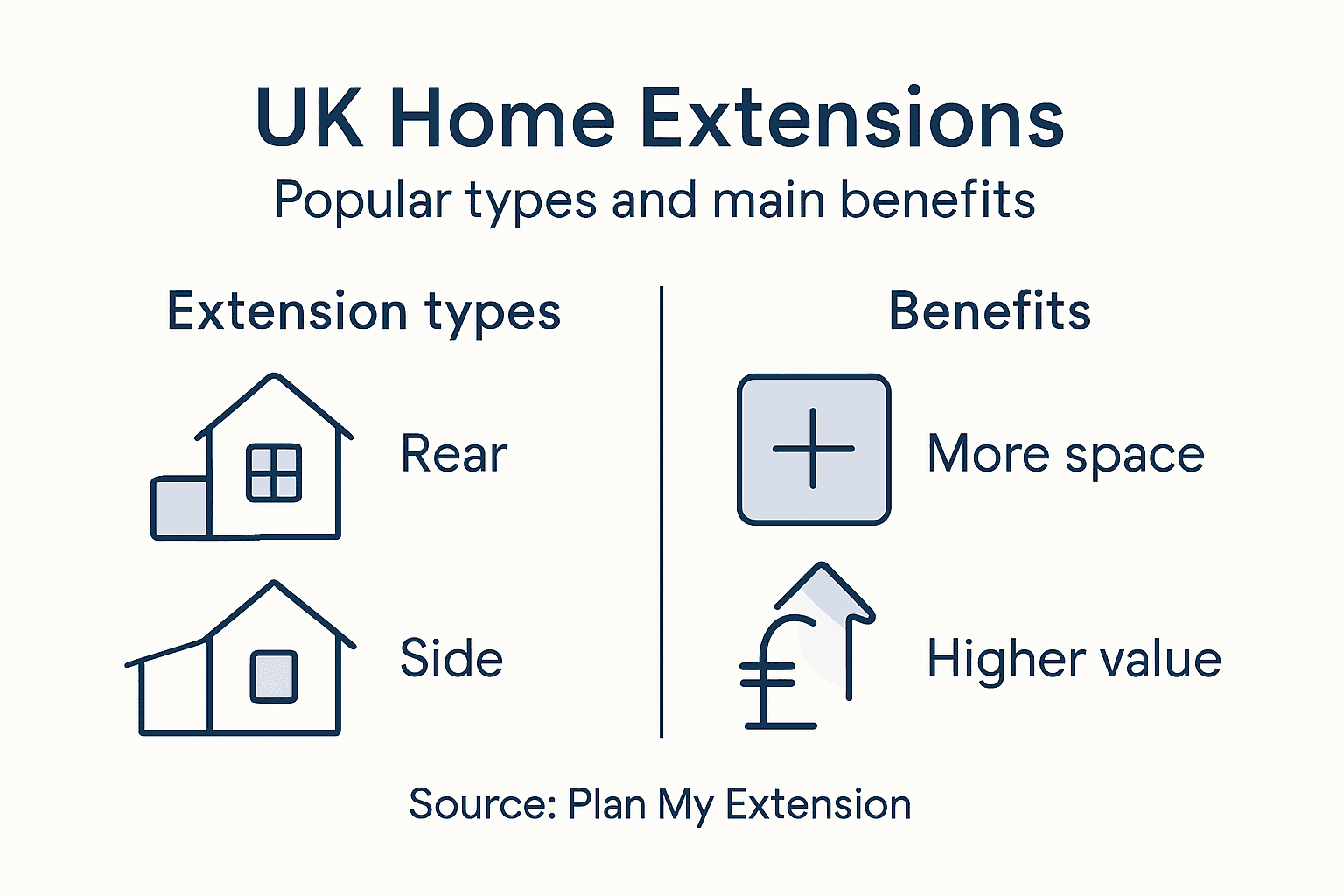
Rear extensions are particularly popular, typically extending the ground floor to create additional kitchen or living area space. Side extensions often utilise unused space alongside the property, enabling homeowners to expand without significantly altering the property’s original footprint. Loft conversions transform unused roof spaces into functional living areas, which can add substantial value and create bedrooms, home offices, or recreational spaces without increasing the property’s ground-level dimensions.
Here is a quick comparison of the most common UK property extension types:
| Extension Type | Typical Use | Impact on Home Value |
|---|---|---|
| Rear Extension | Enlarged kitchen or lounge | High value increase |
| Side Extension | Additional ground space | Moderate value boost |
| Loft Conversion | New bedroom or office | Significant added value |
| Conservatory | Light-filled living area | Modest value enhancement |
Some extension types require careful navigation of leasehold reform and building regulations, particularly for flats and properties with complex ownership structures. Homeowners must consider factors such as permitted development rights, potential planning permission requirements, and the specific building regulations that apply to different extension types. These regulations can vary depending on the extension’s size, location, and potential impact on neighbouring properties.
Pro tip: Always consult with local planning authorities and a professional architect to understand the specific requirements and potential constraints for your chosen extension type before commencing any construction work.
Planning permission and building regulations
Navigating the complex landscape of home extensions requires a thorough understanding of planning permission and building regulations. These two distinct but interconnected processes are crucial for ensuring that any property modification meets legal requirements, maintains neighbourhood standards, and guarantees structural safety and sustainability.
Planning permission focuses on the external impact of your proposed extension, examining how the new structure will affect the local environment, streetscape, and neighbouring properties. Local authorities assess factors such as the extension’s size, design, materials, and potential visual or environmental implications. In contrast, building regulations concentrate on the technical aspects of construction, covering critical areas like structural integrity, fire safety, energy efficiency, accessibility, and overall building performance.
Homeowners must recognise that building regulations approval is typically required for most extension projects, regardless of whether planning permission is necessary. This means that even small modifications may need formal assessment to ensure they meet national construction standards. The process involves submitting detailed plans to the local building control department, who will review the technical specifications and may require site inspections during and after construction to confirm compliance.
Pro tip: Consult a professional architectural service early in your planning process to help you understand the specific planning and building regulation requirements for your unique property extension project.
Choosing designs, builders and packages
Selecting the right team and approach for your home extension is a critical decision that can significantly impact the project’s success. Choosing a trusted builder requires careful consideration, research, and a strategic approach to ensure quality, reliability, and value for your investment.
When evaluating potential builders, homeowners should prioritise several key factors. Professional credentials are paramount – look for builders who are members of reputable trade associations, carry comprehensive insurance, and can provide verifiable references from previous projects. Detailed quotes are essential, with transparent breakdowns of costs, materials, timelines, and specific project specifications. This allows for accurate comparison between different builders and prevents unexpected expenses or misunderstandings during the construction process.
Design packages vary widely, and selecting the right one depends on your specific requirements, budget, and property characteristics. Obtaining multiple quotes with comprehensive specifications enables homeowners to make informed decisions. It’s crucial to have clear, written agreements that outline every aspect of the project, from initial design concepts to final construction details. Communication is key – ensure your chosen builder understands your vision and can translate your ideas into a practical, aesthetically pleasing extension that meets both your functional needs and local building regulations.
Pro tip: Always request a minimum of three detailed quotes from different builders, and don’t automatically choose the cheapest option – consider expertise, reputation, and comprehensive service.
Costs, risks and common mistakes
Home extensions represent a significant financial investment with potential complexities that can catch unprepared homeowners off guard. Understanding potential risks is crucial to avoiding costly mistakes and ensuring a successful renovation project.
Financial risks are perhaps the most immediate concern for most homeowners. Extensions frequently exceed initial budget estimates due to unexpected structural challenges, material price fluctuations, or complex design requirements. Professional estimates suggest budgeting an additional 10-20% above initial quotes to accommodate potential contingencies. Key cost considerations include not just construction expenses, but also professional fees for architects, surveyors, and potential planning permission applications, which can quickly escalate project expenses.
Non-compliance represents another critical risk area that can lead to substantial financial and legal complications. Failing to obtain proper building regulations approval or breaching local planning permissions can result in enforcement actions, potentially requiring expensive retrospective alterations or even complete demolition. Lease extension costs can also vary dramatically depending on property specifics, making thorough research and professional consultation essential before commencing any extension project.
Below is a summary of major risks and key cost considerations for home extensions:
| Risk/Cost Factor | Why It Matters | How to Mitigate |
|---|---|---|
| Budget Overruns | Unforeseen expenses arise | Contingency fund, accuracy |
| Planning Non-compliance | Fines or forced alterations | Follow regulations closely |
| Rising Material Costs | Impacts final project expense | Secure fixed-price quotes |
| Professional Fees | Can escalate project budget | Compare detailed estimates |
Pro tip: Create a comprehensive contingency fund of at least 15-20% of your total project budget to protect against unexpected expenses and potential complications during your home extension.
Simplify Your Home Extension Journey Today
Expanding your living space with a home extension brings many challenges from navigating planning permission to choosing the right design and builder. If you feel overwhelmed by the technical jargon and uncertain about legal requirements like building regulations or leasehold reform, you are not alone. Many homeowners want to avoid costly mistakes and budget overruns that frequently arise during these projects. Understanding key steps such as securing planning approval and selecting trusted professionals is essential for a successful extension.
Take control of your home extension process with Plan My Extension, your trusted online platform offering fixed-price architectural drawings tailored for each stage—from planning permission to technical designs. Our remote service lets you bypass expensive architects and lengthy site visits while ensuring compliance with UK building standards. Connect effortlessly with vetted local builders to bring your vision to life and stay on budget. Start your extension journey now by visiting Plan My Extension and discover how simple expanding your home can be.
Frequently Asked Questions
What is a home extension?
A home extension is the process of enlarging an existing property by constructing additional rooms or areas that connect to the current structure, enhancing both the property’s functionality and living comfort.
What types of home extensions are available?
Common types of home extensions include single-storey rear extensions, side extensions, loft conversions, and conservatories, each serving different purposes and offering unique benefits to homeowners.
Do I need planning permission for a home extension?
Yes, most home extensions require planning permission, which assesses the proposed extension’s impact on the local environment and its compliance with building regulations.
What are the main risks associated with home extensions?
Key risks include budget overruns due to unforeseen expenses, compliance issues leading to fines or retrofitting, and escalating professional fees. To mitigate these risks, it’s advisable to create a contingency fund and thoroughly research regulations.
Recommended
- Bricks, Mortar & Maintenance: Materials for Durability – Plan My Extension
- A Homeowner’s Guide to Extending Without the Headache Easily – Plan My Extension % %
- Measuring Your Home: What We Need from Your Survey – Plan My Extension
- Single-Storey vs Two-Storey Extensions: Which is Right for You? – Plan My Extension