Skip to content


Planning a home extension in England often feels more complicated than it should be. With councils requiring detailed proposals and strict adherence to both local and national policies, even simple projects can seem daunting. Understanding the planning application process is vital if you want to avoid delays, extra costs, or outright refusals. This guide breaks down how the process works, what types of applications exist, and how to confidently move your extension plans forward with remote architectural support.
Table of Contents
- What Is A Planning Application Process?
- Types Of Planning Applications Explained
- Step-By-Step Application Procedure In 2026
- Legal Requirements And Recent Reforms
- Typical Costs, Timeframes, And Pitfalls
Key Takeaways
| Point | Details |
|---|---|
| Understand the Application Process | Familiarise yourself with the planning application process to ensure compliance with local and national policies. |
| Determine Application Type | Identify whether your project requires a Householder Application or qualifies for Permitted Development to save time and resources. |
| Prepare Detailed Documentation | Submit complete and high-quality documents to prevent delays and increase chances of approval. |
| Plan for Timelines and Costs | Allow appropriate time for processing and budget for all associated fees to avoid complications during construction planning. |
What Is a Planning Application Process?
A planning application is your formal request to your local council to build, extend, or alter your property. Think of it as asking permission before you start work. The process exists because councils need to review proposals against local and national policies to ensure developments fit with their area’s character, infrastructure capacity, and community needs. When you submit an application for a home extension, you are essentially telling your council “Here’s what I want to build, here’s how I’ll build it, and here’s why it won’t cause problems.” The council then decides whether to grant permission, refuse it, or ask for changes.
The planning application process involves several key stages that flow from submission through to decision. First, you submit your application with the necessary drawings, supporting documents, and fees to your local planning authority (LPA). The council then validates your submission to check you have provided everything required. Once validated, your application enters the public domain and appears on the council’s online register, allowing neighbours and interested parties to view the details and make comments. During this consultation period, the council also notifies relevant bodies like environmental agencies or highways authorities if needed. Finally, a planning officer reviews all the information submissions, objections, and consultations before reaching a decision. This structured framework ensures community input and statutory consultation are properly accounted for rather than decisions being made behind closed doors.
For homeowners planning extensions, understanding what type of application you need matters greatly. Some works fall under Permitted Development, which means you can proceed without planning permission if you meet specific criteria like size, height, and proximity to boundaries. Others require what’s called a Householder Application, which is a faster process designed specifically for domestic extensions. The drawings you submit must show the proposed extension clearly, including dimensions, materials, and how it relates to your existing house and neighbours’ properties. Many homeowners underestimate how detailed these drawings need to be, but councils expect them to demonstrate that your design is sensible and won’t negatively impact the area. Knowing whether your project qualifies for Permitted Development or needs a Householder Application from the outset saves considerable time and frustration.
What makes this process feel daunting for most homeowners is the uncertainty around timescales and outcomes. Typically, councils have 13 weeks to make a decision on householder applications, though this can extend if they ask for further information or if the application goes to committee. Some approvals come through in four weeks, whilst others drag on longer. The decision ultimately depends on whether your proposal complies with local policies, whether neighbours object, and whether any specialist consultations raise concerns. Throughout this entire process, communication with your council matters. If they ask questions or need clarification on your drawings, responding promptly keeps things moving forward.
Pro tip: Before submitting your application, request a pre-application consultation with your local planning authority to discuss your extension concept informally. This costs little or nothing and often reveals potential issues early, allowing you to refine your design before formal submission, which can significantly improve your chances of approval.
Types of Planning Applications Explained
Not all planning applications are the same. The type you need depends entirely on what you are proposing to do with your property. Understanding the differences between application types matters because each has different requirements, costs, timescales, and chances of success. Submitting the wrong type can waste time and money, whilst choosing correctly sets you up for a smoother process. The good news is that the main types fall into relatively clear categories, and once you understand your options, identifying which one applies to your extension becomes straightforward.
The most common application types for homeowners are full planning permission and outline planning permission. Full planning permission requires you to submit detailed designs showing exactly what you intend to build, including dimensions, materials, site layout, and how the extension relates to existing structures and neighbours’ properties. The council assesses everything in detail and makes a final decision based on the complete information you provide. This is the standard route for most domestic extensions. Outline planning permission, by contrast, establishes the broad principles of what you can build on the land without requiring all the detailed design specifications upfront. You might use outline permission to confirm that an extension is acceptable in principle before commissioning detailed architectural drawings. However, outline permission is less common for residential extensions because homeowners typically want to proceed directly to full permission with their designs already prepared. Full applications assess detailed proposals thoroughly, whilst outline applications focus on establishing feasibility before detailed work begins.

Beyond these two main types, you may encounter Permitted Development, which is not technically a planning application at all. Permitted Development rights allow you to carry out certain works without needing to apply for planning permission, provided they meet strict criteria regarding size, depth, height, and distance from boundaries. Many single-storey extensions qualify under Permitted Development rights, which means you can proceed to building control stage without council planning permission. If your extension falls under Permitted Development, you save the planning application fees, the consultation period, and the risk of refusal. However, Permitted Development does not exempt you from building control approval, which ensures your extension meets structural and safety standards. Another application type you might need is Prior Approval, which applies to certain Permitted Development works that still require approval of specific details like materials or design. Additionally, Lawful Development Certificates confirm that existing uses or structures have legal permission through age or Permitted Development rights, useful if you are unsure whether past works obtained the necessary approvals.
For householders planning extensions, you will most likely need either a standard Householder Application (full planning permission) or you will discover your scheme qualifies for Permitted Development. The householder route exists specifically to streamline applications for domestic extensions and is quicker than full applications because they cannot be called in for appeal to a planning inspector. Understanding whether you need planning permission at all, and if so, what type, saves considerable time. Planning applications vary from full applications detailing all site developments to outline applications establishing basic parameters. Some schemes may require approval of reserved matters, where outline permission was granted previously and you now submit the detailed designs for final approval. Others might need discharge of conditions, amending an existing permission if your circumstances have changed.
Here’s a comparison of common planning application types for household extensions in England:
| Application Type | Key Characteristics | Advantages | Typical Usage Scenario |
|---|---|---|---|
| Full Planning Permission | Requires detailed designs | Thorough council assessment | Large or complex extensions |
| Outline Planning Permission | Broad principles, few details | Confirms feasibility | Early-stage or uncertain cases |
| Householder Application | Streamlined for domestic works | Faster and lower risk | Standard home extensions |
| Permitted Development | No formal application | Quick progression, lower cost | Small extensions meeting criteria |
| Prior Approval | Focused approval for details | Covers specific concerns | Certain permitted works |
| Lawful Development Certificate | Legally confirms status | Removes future doubts | Verifying past unauthorised works |
Pro tip: Before determining which application type you need, obtain a written confirmation from your local planning authority stating whether your extension qualifies for Permitted Development or requires a householder planning application. This single step, often provided free or for a small fee through pre-application advice, eliminates guesswork and prevents submitting the wrong application type.
Step-By-Step Application Procedure in 2026
Once you have decided to submit a planning application for your extension, the actual process follows a predictable sequence of steps. Each stage has specific requirements and timescales. Knowing what happens at each point removes uncertainty and helps you prepare the right documents before submission. The procedure is designed to be transparent, giving you and your neighbours a chance to have input whilst the council assesses your proposal fairly.
Step 1: Prepare Your Application Documents
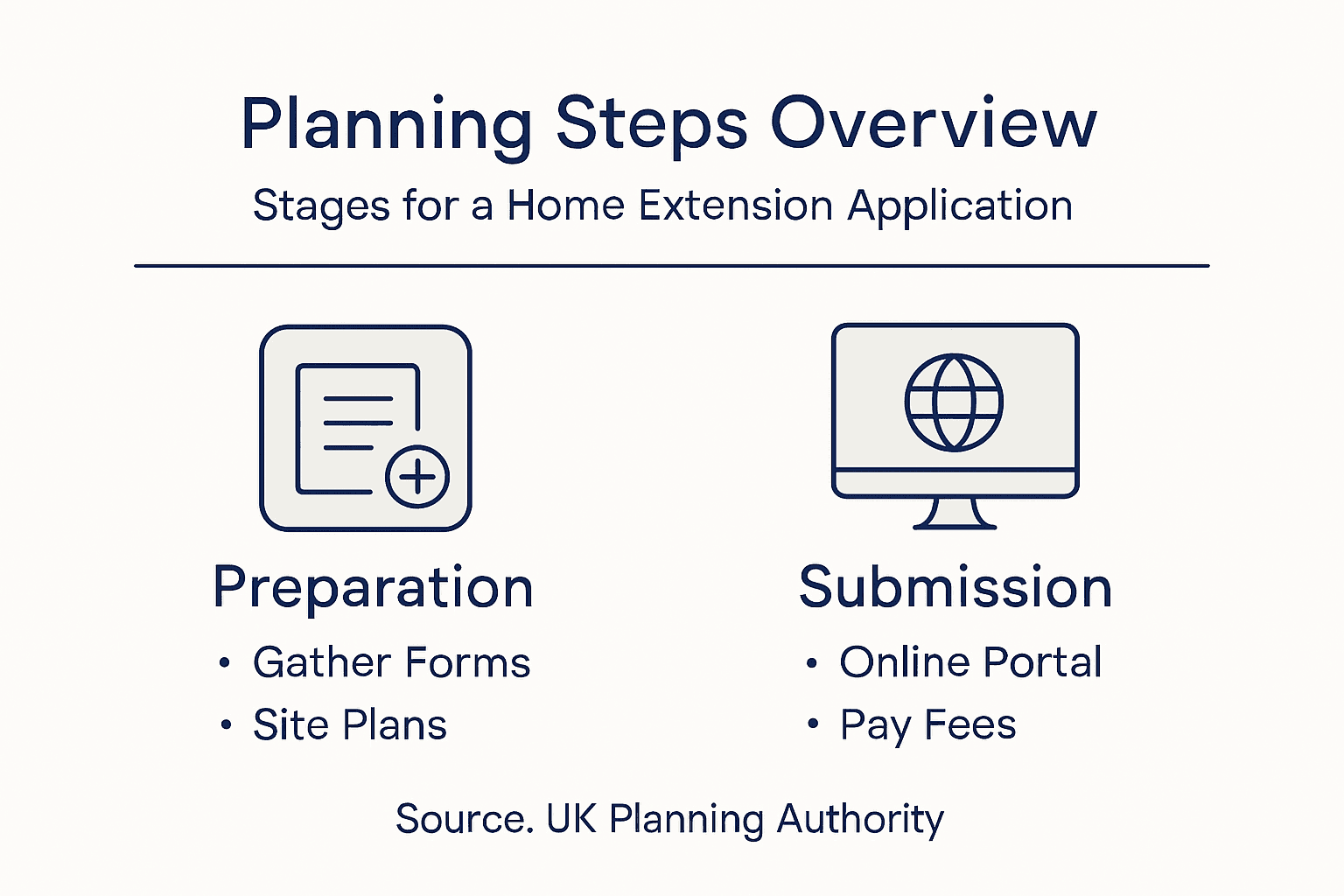
Before you submit anything, gather everything the council requires. You will need a completed application form specific to your local authority, copies of your site plan showing the property boundaries and surrounding context, detailed drawings of the proposed extension showing dimensions and materials, existing plans of your house, and a Design and Access Statement explaining your choices. You may also need to submit photographs of the existing property, a location plan showing the wider area, and heritage information if your property sits within a conservation area or is listed. Different councils have slightly different requirements, so check your local planning authority’s website for their specific checklist. Preparing these documents thoroughly at this stage prevents the council rejecting your application as invalid and sending you back to square one.
Step 2: Submit Your Application and Pay the Fee
Most councils now accept applications online through their planning portal. You upload your documents, complete the application form, and pay the appropriate fee. Fees vary by council and depend on the extension size and total cost. For a typical single-storey extension, you might expect fees ranging from £170 to £400. Keep your application reference number safe because you will need it to track progress and correspond with the council. Submitting online is usually quicker than paper submission and gives you immediate confirmation of receipt.
Step 3: Validation
Once submitted, the council checks that your application is valid meaning you have provided all required documents and information. This typically takes 5 to 10 working days. If anything is missing, the council will contact you and ask you to submit the missing documents. Incomplete applications can cause delays, so responding quickly when councils ask for additional information keeps your application moving forward. Once the council confirms your application is valid, it enters the formal consultation period.
Step 4: Public Consultation and Notification
The council publishes your application on its online planning register for public inspection. Publicity and consultation take place, allowing affected parties to comment. The council typically notifies neighbours directly by letter and advertises the proposal. The consultation period usually runs for 21 days, though some councils extend this. During this time, neighbours and other interested parties can submit comments supporting or objecting to your scheme. You can see what people have said about your application by checking the planning register. Do not worry if objections appear; the council assesses all comments but makes decisions based on planning policy, not popular opinion.
Step 5: Council Assessment and Consultation With Specialists
Whilst the public consultation runs, the council’s planning officers assess your proposal against local and national planning policies. They consider design, impact on neighbours, parking, highways, and other relevant factors. The council may also consult specialist bodies such as highways authorities, environmental teams, or conservation officers depending on your scheme’s nature. These consultations inform the planning officer’s assessment and recommendation.
Step 6: Decision
The planning officer prepares a report recommending approval, approval with conditions, or refusal. For straightforward householder applications, the officer usually makes the decision. For more controversial applications, the decision goes to the planning committee where councillors vote. The council aims to make decisions within 13 weeks of validation for householder applications, though complex schemes can take longer. You will receive formal written notification of the decision, and it also appears on the online planning register. If approved, you will receive the decision notice detailing any conditions you must satisfy before starting work.
Step 7: What Happens Next After Decision
If approved, you must comply with any conditions stated in the decision notice before commencing work. These might require approval of materials, landscaping details, or other elements. Once conditions are discharged, you can apply for building control approval and begin construction. If refused, you have the right to appeal within 3 months of the refusal, though appeals are complex and expensive. Many homeowners choose to revise their design based on council feedback and resubmit a fresh application instead.
Pro tip: Submit your application well ahead of any preferred start date for construction, because you will need to allow at least 13 weeks for the planning decision, then another 4 to 8 weeks for building control approval once planning permission is granted. Rushing the process often leads to mistakes or incomplete documentation that delays everything.
Legal Requirements and Recent Reforms
Planning law in England exists to balance competing interests: enabling development that communities need whilst protecting the environment, heritage, and quality of life. Understanding the legal framework behind planning applications helps you see why councils make certain decisions and what standards your extension must meet. The law has evolved significantly in recent years, with reforms designed to speed up processes, increase transparency, and encourage sustainable development.
The foundation of planning law is the Town and Country Planning Act 1990, which sets out the basic rules for what requires permission and how decisions are made. Supporting this is the National Planning Policy Framework (NPPF), a government document that guides local planning authorities in making decisions consistently. The NPPF emphasises sustainable development, meaning development that meets present needs without damaging future generations’ ability to meet theirs. When your local council assesses your extension, they apply your adopted Local Plan (which sets out what development is acceptable in your area) against the NPPF’s principles. The legal framework for planning ensures developments respect environmental protections and community interests through statutory consultation and appeals mechanisms. You cannot appeal against the law itself, but you can appeal a council’s decision if you believe they have not applied the law correctly or have acted unreasonably.
Recent reforms have fundamentally changed how the planning system operates. The government introduced what is called the “planning guarantee,” requiring councils to make decisions on most applications within strict timeframes. For householder applications like extensions, this means 13 weeks from validation to decision. Councils that fail to meet these targets can face sanctions, creating pressure to process applications efficiently. The government also mandated digitisation of planning processes, meaning councils must accept online applications and publish decisions on searchable registers. This transparency benefits you because you can see exactly what was decided about your application and why. Recent reforms streamlined processes and increased local engagement, including online registers and enhanced transparency in decision-making. Additionally, reforms now require authorities to co-operate with neighbouring councils on matters of regional importance like housing and infrastructure, ensuring decisions are not made in isolation.
Environmental and social considerations have become increasingly embedded in planning law. Councils must now assess applications against climate change objectives, ensuring new buildings are designed for energy efficiency and resilience. If your extension involves listed building work or sits within a conservation area, additional legal protections apply. You cannot make changes that harm the building’s character without special consent. Heritage asset protection is not optional; it is a legal requirement your council must enforce. Affordable housing requirements also appear in some Local Plans, though these typically apply to larger developments rather than individual extensions. The legal requirement to consider sustainable development means your extension should not create unnecessary environmental harm, excessive parking demand, or strain on local infrastructure. These legal requirements explain why councils sometimes refuse extensions that neighbours might have accepted, because the law requires them to consider broader sustainability factors.
Understanding these legal requirements helps you prepare stronger applications. If you design your extension to align with your Local Plan policies, incorporate sustainable design principles, and demonstrate respect for your property’s character and neighbours’ interests, you are already building a compelling case. The law requires councils to be consistent and transparent, which works in your favour if your proposal is genuinely compliant. Conversely, if your extension clearly breaches local policies or creates demonstrable harm, no amount of persuasive presentation will overcome those legal objections.
Pro tip: Before investing time and money in detailed extension designs, obtain and read your local planning authority’s adopted Local Plan and the relevant design guidance for your area. These documents reveal exactly which policies your extension must satisfy legally, allowing you to design something compliant from the start rather than discovering planning obstacles after spending money on drawings.
Typical Costs, Timeframes, and Pitfalls
Planning applications cost money, take time, and can go wrong if you are not careful. Understanding realistic costs and timescales helps you budget properly and avoid nasty surprises. Most homeowners underestimate both the financial investment and the patience required, which leads to frustration when applications take longer than expected or face unexpected objections.
Planning Application Costs
Planning application fees vary significantly depending on your local authority and the scale of your extension. For a typical single-storey rear extension, you can expect to pay between £170 and £400 to your council. A two-storey extension might cost £500 to £750. These fees are non-refundable, meaning you pay even if your application is refused. However, the council’s fee covers only their processing costs. You will also need to budget for professional support unless you submit drawings yourself. Architectural drawings specifically prepared for planning applications typically cost between £800 and £2,500 depending on the extension’s complexity and the architect’s experience. If your property sits within a conservation area or is listed, you may need specialist heritage advice, adding another £300 to £800 to your costs. Some applications require environmental or tree surveys if your extension affects protected species or trees, costing £200 to £600 each. Think of the total financial commitment as an investment in getting approval right rather than a simple fee payment.
To help plan your application, here’s an overview of typical extension costs and timescales:
| Item | Typical Cost Range | Timeframe Estimate | Notes |
|---|---|---|---|
| Council Planning Fee (single-storey) | £170 – £400 | 3–4 months total | Non-refundable, varies by council |
| Council Fee (two-storey extension) | £500 – £750 | 3–5 months total | Higher for complex or large projects |
| Architectural Drawings | £800 – £2,500 | 2–4 weeks preparation | Costs depend on project complexity |
| Heritage/Environmental Surveys | £200 – £800 | Additional weeks if needed | Required for conservation/listed sites |
| Building Control Approval | £200 – £500 | 4–8 weeks after planning | Separate from planning process |
Realistic Timeframes
Typical planning applications have statutory determination periods: eight weeks for most minor works and thirteen weeks for householder applications. However, these are maximum periods, not typical ones. Many straightforward extensions receive decisions within four to six weeks if the application is valid, complete, and uncontroversial. Conversely, if the council requests additional information, the clock pauses whilst you provide it, adding weeks to the process. Applications that go to planning committee rather than officer decision can take significantly longer. Committee meetings often happen monthly, so if your application misses one meeting, you wait another month for the next opportunity. The consultation period adds time too. After validation, the council publishes your application for at least twenty-one days, during which neighbours can object. Even if no objections emerge, the council still waits the full consultation period before progressing assessment. From initial submission to decision typically takes three to four months for straightforward householder extensions, not the eight or thirteen weeks councils cite as their maximum.
Common Pitfalls That Delay or Derail Applications
The biggest pitfall is submitting an incomplete application. Missing drawings, unsigned forms, or inadequate design statements cause the council to reject your application as invalid, sending you back to the start. This wastes weeks. Always check your local authority’s validation checklist obsessively before submission.
Another frequent mistake is ignoring or underestimating consultation feedback. If your plans show parking removed or trees cut down, expect objections. Simply hoping objections will be ignored does not work. The council must consider all comments received. If your design genuinely causes problems that neighbours raise during consultation, you will need to either defend your position with evidence or revise the scheme.
Failing to align your design with local planning policies causes refusals. Every Local Plan contains policies about extensions, such as maximum roof heights, setback distances from boundaries, or requirements for matching materials. Extensions that breach these policies struggle to gain approval regardless of their merit. This is why reading your Local Plan before designing is crucial.
Poor quality drawings represent another pitfall. Sketchy, unclear, or dimensionally incorrect drawings frustrate council officers and sometimes make assessment impossible. Professional architectural drawings might cost more upfront, but they prevent costly delays and refusals later.
Underestimating timescales causes problems too. Homeowners sometimes assume they will have permission in eight weeks and book builders accordingly. When the application takes four months because of objections or committee involvement, contracts with builders fall through or expensive delays occur. Always build extra buffer time into your schedules.
Finally, many homeowners proceed without pre-application advice. A brief conversation with your planning officer before formal submission costs little or nothing and reveals potential issues early. This single step prevents most major pitfalls.
Pro tip: Budget for the full cost of professional architectural drawings and submit your application at least four to five months before your preferred construction start date. This timeline accommodates the thirteen-week maximum plus building control approval, preventing the schedule pressures that cause corners to be cut and mistakes to multiply.
Simplify Your Planning Application Process With Expert Support
Navigating the planning application process can feel overwhelming with its complex terminology like Householder Application and Permitted Development, not to mention strict timeframes and detailed document requirements. If you want to avoid delays, costly mistakes, or uncertainty around council decisions, our platform at Plan My Extension is designed with you in mind. We offer fixed-price, fully remote architectural drawings tailored specifically for extensions, helping you produce professional, council-compliant plans quickly without the usual hassle.
Start your extension journey with confidence today. Visit us at Plan My Extension to explore our straightforward online process. Benefit from expert drawings for your planning application and technical building control needs all in one place. Plus, connect seamlessly with trusted local builders ready to turn your plans into reality. Don’t let bureaucratic hurdles stand in the way. Take control now with our easy, transparent service and secure your planning permission faster.
Frequently Asked Questions
What is the planning application process?
The planning application process is the formal procedure through which homeowners request permission from their local council to build, extend, or alter their property. It involves several stages, including submission, validation, public consultation, assessment, and decision-making by the council.
How long does it take to get a decision on a planning application?
Typically, councils aim to make a decision on householder applications within 13 weeks of validation. However, this timeframe can vary based on factors such as the complexity of the application, the need for additional information, and whether the application requires a committee decision.
What types of planning applications can I submit for my home extension?
The main types of planning applications homeowners can submit include full planning permission, outline planning permission, householder applications, permitted development rights, prior approval, and lawful development certificates. The type you need depends on the nature of your proposed extension.
What should I include in my planning application documents?
Your planning application should include a completed application form, site plan, detailed drawings of the proposed extension, existing plans, a Design and Access Statement, photographs of the property, and any additional information required by your local council. Checking your local authority’s specific checklist is crucial to avoid application rejection.